


The virtual Academy
Auteur(s)
-
J.Michaël Moshell
- Couriel :
-
Charles E.Hugues
- Couriel :
Institut(s)
-
University of Central Florida
- URL : http://www.vcf.edu
Projet : ExploreNet
Film(s) et Image(s) Extraite(s): 320*240
|
Film
1 |
Video QuickTime -> |
 (4.0 Mo)
|
|---|---|---|
| Images Jpeg -> |
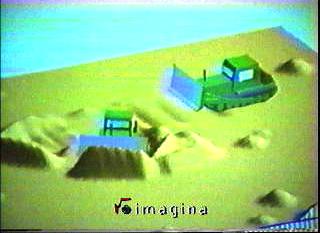 (13 Ko)
|
Description
plans for educational project in cyberspace where students help one another in a role playing game
-
Date de Réalisation : 2:94
-
Categorie : Conférences
-
Mots Clefs :
- MVD
- habitat
-
Thème(s) :
Complément d'information
-
Bibliographie :
"The Virtual Academy: Networked Simulation and the Future of Education",1994 Imagina proceedings pp200-217
-
Résumé :
The goal: how do we transform an educational system that was designed in the nineteenth century for an agricultural society, so as to prepare citizens for the cybernetic twenty-first century ? The tools: networked real-time graphical simulations of many kinds, including Virtual Environments (VE). A virtual environment is a simulation which immerses the participant - that is, it monopolizes the user's senses. The problems: there are difficulties at every level. We sometimes divide virtual environment technology into three layers:- World building - the artistic enterprise of translating a body of subject matter into a model capable of being simulated in an interactive fashion.
- Tool building - the creation of software tools for computer-aided design (CAD), interactive specification of constraints and properties, and the integration of components into a coherent simulation.
-
System building - the design and construction of hardware and software
which solves the basic problems of computation, communication and the
transformation of information. Products and results at this level tend to
be of much broader applicability than just simulation.
In order to get to the point where we can seriously address educational issues, we must create a critical mass - a group of people with the skills, tools and time to address problems at all three levels. These people must constantly exchange ideas, request and receive support from one another, and serve as each other's "customers".This paper describes how the United State Army and the University of Central Florida have collaborated to create that critical mass at the Institute for Simulation and Training (IST). Beginning with lessons learned from the SIMNET program, IST has led the simulation industry in defining the Distributed Interactive Simulation communications protocol.
IST's Visual Systems Laboratory (VSL) has built up a strong capacity in the creation of real-time simulations and visual databases. Simultaneously, the academic side of the University has developed courses in computer animation, graphics and simulation, and created a broad collaboration with the Orange County Public School system.
We now have in place a testbed incorporating elementary, middle, high school and university classrooms, as well as specialized academy for exceptional education. All are equipped with state of the art computing equipment, and are being used to support experiments in simulation-based learning. A central principe of the entire project is that students should use technology to teach older students. The next step is to extend this model across multiple universities and communities. To achieve this goal, the Virtual Academy will link four to six universities together with several public schools in a shared virtual environment. University students and faculty will design educational materials which are then provided via telecommunications to the schools. Older school students will collaborate in lesson construction (e.g. by providing CAD designs, conducting experiments, etc...) and deliver the lessons to younger students.This paper describes the concrete details of the Virtual Academy and its antecedents. Videotapes and explanations will be presented of:
- Distributed Interactive Simulation from the military perspective. from SIMNET through the Battle of 73 Easting.
- The Dynamic Terrain Project and the creation of Virtual Environment Tools.
- The Army Research Institute Virtual Environment Training Testbed project.
- The Toy Scouts, a student organization which builds virtual worlds and teaches younger students.
- ExploreNet a low-technology role playing game that serves as a PC-based precursor to fully immersive virtual environments. In the years between 1994 and 2000, the Virtual Academy will serve as a laboratory in which ideas about collaborative learning, peer teaching, and distributed simulation wiII be developed and tested. The necessary skills for our future citizens - mastery of electronic information, problem solving and teamwork - will be developed as the students themselves assist our research team in inventing the educational system of the future.
-
Commentaires supplementaires :
information from a fax sent by Michaël Moshell