


Ce document n'est pas traduit, désolé...
The Responsive Workbench
Image(s): 640*480
 Jpeg Image (46 Ko)
|
Author(s)
-
Monika Fleischmann
- Email :
Institute(s)
-
German National Research Center for Computer Science (GMD)
- URL : http://viswiz.gmd.de
- Country : Germany
Project : contact: Wolfgang Strauss, Bernd Fröhlich, Gerold Wesche
Video(s) and extracted images: 320*240
|
Film
1 |
Video QuickTime -> |
 (3.7 Mo)
|
|---|---|---|
| Jpeg Images -> |
 (13 Ko)
|
|
Film
2 |
Video QuickTime -> |
 (3.0 Mo)
|
|
|---|---|---|---|
| Jpeg Images -> |
 (11 Ko)
|
 (11 Ko)
|
|
|
Film
3 |
Video QuickTime -> |
 (3.5 Mo)
|
|---|---|---|
| Jpeg Images -> |
 (11 Ko)
|
Description
Aims
The Responsive Workbench concept is an alternative to the muliti-media and virtual reality models of the past decade. In this new concept the user no longer experiences simulations of the world on the computer, but the computer is (invisibly) integrated into the user's world. Everyday objects and activities become inputs and outputs for this environment. For instance, objects are displayed on a table in 3D.The user interacts with this virtual scenario, manipulates it as if real, and upon request obtains information from the computer in the background.Scenario
Virtual objects and control tools are located in a real "workbench". The objects, displayed as computer generated stereoscopic images are projected onto the surface of a table. The computer screen is changed to a horizontal, enlarged workshop version and replaces the two dimensional flat screen. This new corresponds to the actual work situation in an architect's office, at surgery environments, on the workbench, for three-dimensional atlases, etc.The work action is virtual. A guide uses the virtual working environment while several observers can watch events through shutter glasses. The guide operate within a nonimmersive virtual reality environment.
Depending on the application, various input and output modules can be integrated, such as gesture and speach recognition systems wich characterize the general trend away from the classical human machine interface. Several guides can work together locally or use global communication networks such as broadband ISDN. "Responsive Environment", consisting of tracking systems, cameras projectors and microphones, replaces the traditional computer workstation. Thus the computer is increasingly adaptated to human needs.
-
Date : 95
-
Category : Conferences
-
Theme(s) :
Technical Information
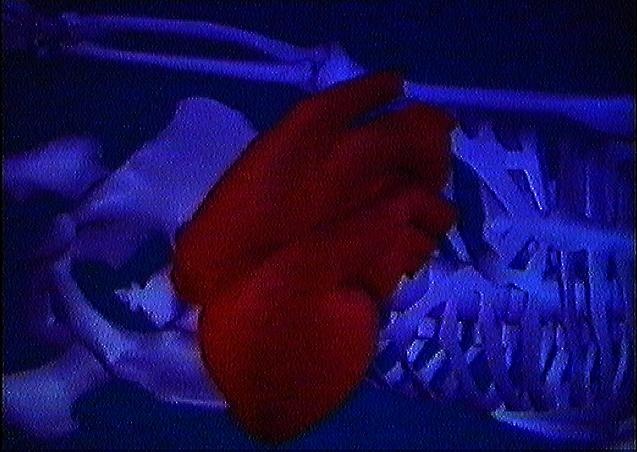
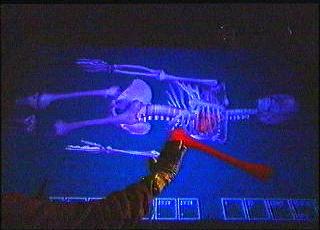
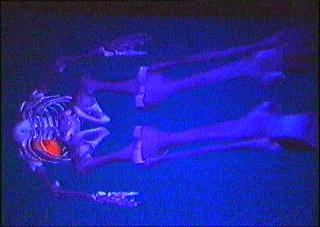
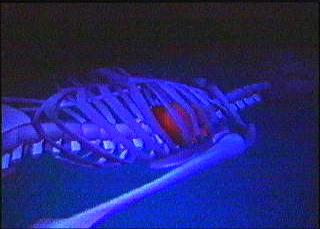
Applications : Based on current research projects on the field of computer graphics, human computer interfaces and visualization, the following applications have been embedded in this new type of environment:- nonsequential medical training: The scenario is based on a real sized model of a patient, who could be examined in any detail through the zooming operation. Especially important are the dynamic aspects, like the beating heart and the blood flow inside of it.
- surgery planning: real datasets from computer tomography (CT) or magnetic resonance imaging (MRI) measurements are visualized using isosurface techniques and semitransparent rendering.
- virtual windtunnel: A car is shown in a typical prototype size 1:4 with some precomputed streamlines. The stylus now serves as a particle injector to examine any area around the car in greater detail.
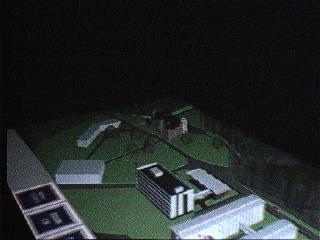
- three-dimensional simulation of design and discussion processes in architecture and landscape planning.
More Information...
-
Bibliography :
"Intuitive Interfaces and responsive enviroments" Imagina proceedings, 1995, pp 253-261
-
Abstract :
Inter-faces of the body in responsive environments The identification with the computer as a "second self" (Sherry Turkle) can be explained by the active control through special interfaces. Stronger than visual or acoustical impressions, it is through our movements that we experience the sense of presence in virtual space.
We navigate with interfaces which allow for the most intuitive kinds of interaction. So far the human being and the computer were connected by awkward devices; not only by eyephone and dataglove, but also by mouse, keyboard and joystick. We are however moving toward natural human interfaces: navigation by means of eye-tracking and by motion, gesture- and speech-recognition, using the body as interface and representation.Our special contribution is the development of imagination systems, where people can actively be involved in the process of an arising work. This led us to a close cooperation between artists and scientists in creating works to simulate virtual realities, their sensory perception and manipulation.
In our view, the computer has to act as an intelligent server in the background, providing necessary information across multi-sensory interaction channels. The visitors reaction, emotion, thoughts - his senses should dominate an interactive work - not the machine. With the House of Illusion a walk-through navigation system is presented where the viewer is a walker. In the spirit of Marcel Duchamp's statement "My feet are my studio", the viewer navigates through Birlinghoven Castle, headquarter of the GMD, which serves as the basis for the three-dimensional model which represents the virtual castle as a building of information and illusion.A wall sized projection screen and stereo glasses involve the audience into this virtual environment. Voice control activates deeper levels of information on the exhibits. One of the visitors guides the tour with the walking simulator placed in front of the screen. The 'feeling of space' strongly corresponds to the movement of the guide's body. Architectural space and its dimensions is experienced by the perception of walking, hearing spatial sound and seeing stereoscopic images.
The Responsive Workbench a new device for Art and ScienceDesign is a process which involves the calculation and checking of the supportive strength of thought structures - a dynamic interaction between brain, eyes and hands. Spatial experience is subsequently transfered into reality by the hand and the body. "The hand is the exterior brain of man", as Immanuel Kant said. In virtual space we enter the process of visual thinking, which does not only involve the eyes and the brain, but also the entire body.The Responsive Workbench concept has been developed as an alternative model to the multimedia and virtual reality sytems of the past. With `Responsive Environments' conventional dialogue concepts for man-machine communication are put into a user-oriented shape, so that virtual objects and tools lie on a real workbench. The objects appear as computer generated images projected onto this workbench. The computer screen is reflected onto a horizontal, enlarged desk.
The user interacts with the virtual scenario, and manipulates by means of motion, gesture and voice. Through shutter glasses the whole scene can be viewed from any desired angle. Seeing becomes a conscious experience of space like we know it from dance.
-
Some external links :
-
 Spatial Navigator
- http://viswiz.gmd.de/VSMD.en/projects.navi.html
-
skywriter
- http://viswiz.gmd.de/VMSD/PAGES.en.projects.skywriter.html
-
Web Space
- http://VISWIZ/VMSD/PAGES/.en/vrml/schloss.wrl
-
-
Some internal links :
-
Same Author
-
 Cyber City Flights
-
-
Some more Comments :
information from a fax sent by M.Fleischmann