


PolyWorld
Author(s)
-
Larry Yaeger
Institute(s)
-
Apple Computer
- Country : USA
Video(s) and extracted images: 320*240
|
Film
"Eating" |
Video QuickTime -> |
 (1.0 Mo)
|
|---|---|---|
| Jpeg Images -> |
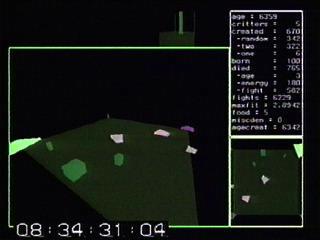 (10 Ko)
|
|
Film
"Fighting/Killing" |
Video QuickTime -> |
 (0.9 Mo)
|
|---|---|---|
| Jpeg Images -> |
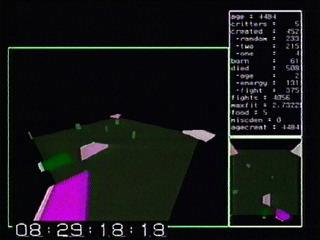 (10 Ko)
|
|
Film
"Mating" |
Video QuickTime -> |
 (1.3 Mo)
|
|---|---|---|
| Jpeg Images -> |
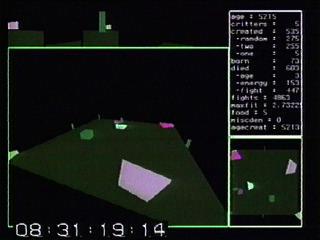 (11 Ko)
|
|
Film
"Lighting" |
Video QuickTime -> |
 (2.3 Mo)
|
|---|---|---|
| Jpeg Images -> |
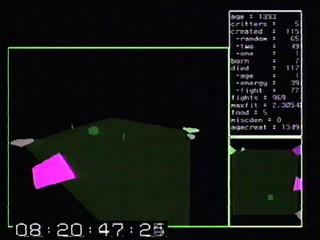 (10 Ko)
|
Description
-
Date : 93
-
Category : Conferences
-
Theme(s) :
More Information...
-
Bibliography :
93 Imagina Proceeding p220-247
-
Abstract :
The study of living system has taken many forms, but only recently have these investigations moved into the realm of artificial systems in computers and robotic hardware. The ecological simulator, PolyWorld, presented here, is one example of an artificial living system.
PolyWorld brings together biologically motivated genetics, simple simulated physiologies and metabolisms, Hebbian learning in arbitrary neural network architectures, a visual perceptive mechanism, and a suite of primitive behaviors in artificial organisms grounded in a simple ecology. Predation, mimicry, sexual reproduction, and even communication are all supported in a straightforward fashion. The resulting survival strategies, both individual and group, are purely emergent, as are the functionalities embodied in their neural network 'brains'.
Complex behaviors resulting from the simulated neural activity are unpredictable, and change as natural selection acts over multiple generations. PolyWorld is a tool for investigating issues relevant to evolutionary biology, ecological systems, ethology, neural systems, and computer science.
This presentation discusses the design principles employed in PolyWorld, along with some of the resulting behavior patterns observed in "species" evolved in it, their neural architectures, the genetic variations observed in large populations under different ecological conditions, and the relation of these behaviors to optimal foraging strategies studied by behavioral ecologists.PolyWorld is an ecological simulator, consisting of a flat ground-plane, possibly divided up by a few impassable barriers, filled with randomly grown pieces of food, and inhabited by a variety of organisms. The inhabiting organisms use vision as input to a neural network brain that employs Hebbian learning at its synapses. The outputs of this brain fully determine the organisms'behaviors. These organisms and all other visible constituents of the world are represented by simple polygonal shapes. Vision is provided by rendering an image of the world form each organism's point of view, and using the resulting pixel map as input to the organism's brain, as if it were light falling in a retina. A small number of an organism's neurons are predetermined to activate a suite of possible primitive behaviors, including eating, mating, fighting, moving forward, turning, controlling their field of view, and controlling the brightness of a few of the polygons on their bodies. Organisms expend energy with each action, including neural activity. They must replenish this energy in order to survive. They may do so by eating the food that grows around the environment. When an organism dies, its carcass turns into food, so they may also replenish their energies by killing and eating each other. Predation is thus modeled quite naturally. The organism's simulated physiologies and metabolic rates are determined from an underlying genome, as are their neural architectures. When two spatially overlapping organisms both express their mating behavior, reproduction occurs by taking the genetic material from the two haploid individuals, subjecting it to crossover and mutation, and then expressing the new genome as a child organism. A variety of different "species" emerge under different environmental conditions, exhibiting recognizable, "lifelike" behavior strategies. The organisms of PolyWorld, surprisingly, fully satisfy Farmer & Belin's list of "properties that we associate with life".
By utilizing both the method (Natural Selection) and the tools (assemblies of neuronal cells) used in the creation of natural intelligence, PolyWorld is an attempt to take the appropriate first steps towards modeling, understanding, and reproducing the phenomenon of intelligence. While one of the grand goals may be the development of a human level (or greater) intelligence in the computer, it would be only slightly less grand to evolve a computational Aplysia that was fully knowable - fully instrumentable, and, ultimately, fully understandable - to let us know that we are on the right path.
-
Some external links :
-
 technical paper, executable program, and source code available at:
- ftp://ftp.apple.com/pub/polyworld/
-