  
Tipsy TurvyImage(s): 640*480
Author(s)
Institute(s)
Video(s) and extracted images: 320*240
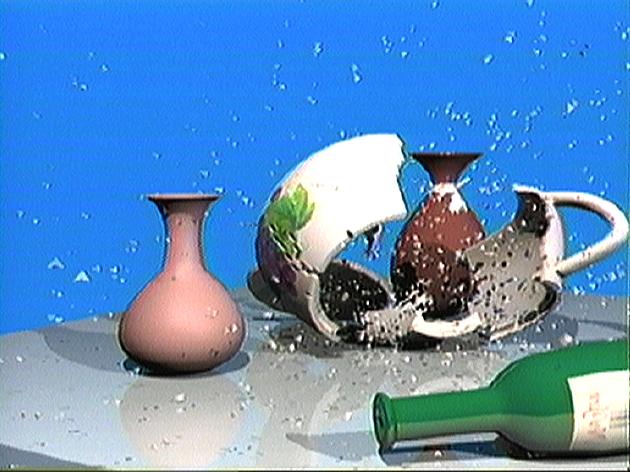
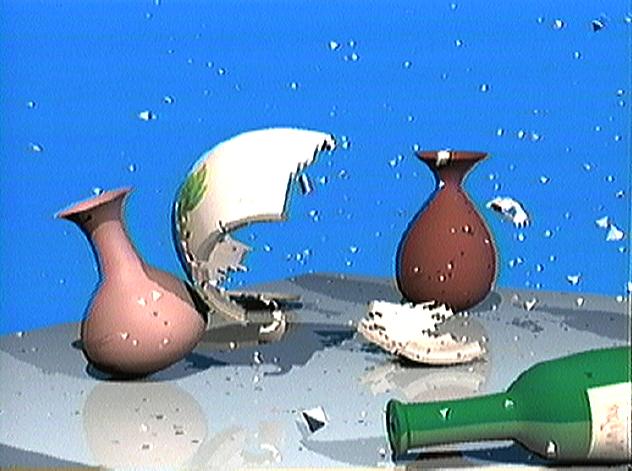
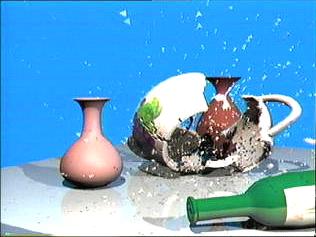
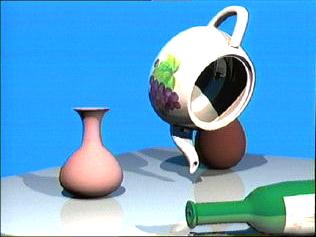
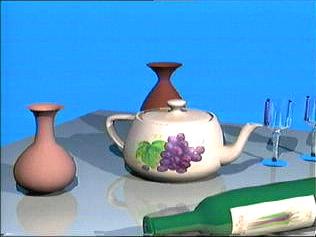
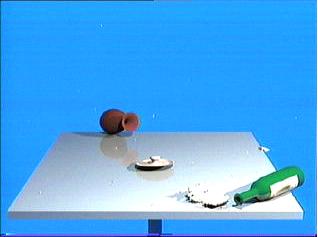
DescriptionAt the start of the animation, the Utah teapot is suffering from a hangover. It hiccups twice, bouncing its lid into the air, startling nearby glassware. Then the teapot sneezes violently, propelling itself and its lid into the air. When the teapot falls back to the table it lands on its spout, and the pot smashes into thousands of pieces. Teapot fragments ricochet off the other occupants of the table, knocking vases and bottles aside. By the time the teapot lid lands, the table has been cleared by the teapot's crash. Technical InformationAll of the behaviors displayed in the animation are the consequence of computer simulation. The "hiccups" were obtained by altering the force of gravity applied to the teapot. The teapot was made to sneeze by briefly softening the ceramic material, then stiffining it again abruptly.
All objects were constructed from a mathematical model that
simulates networks of masses and springs. The internal
dynamics results from the contraction and expansion of
damped springs.
The stiffness of the teapot was limited by the computation
required for a stiff system of differential equations.
Breakage is modelled by introducing a threshold value to the
springs that hold the teapot together. More Information...
| ||||||||||||||||


 Same Institute

- Navigation
- Projects
- Authors
- Dates
- Countries
- Institutions
- Themes
- Categories
- Images
- Films